
For Etsy sellers doing £1,000+ a month
You built the shop. Etsy built the business.
Every order you have ever taken belongs to a customer you are not allowed to email. So we build you a second shop that you own — a storefront designed around what you sell, your catalogue and your reviews carried across, the email engine that brings buyers back, and a card in every parcel that turns an Etsy order into a customer on your list. One build, one price, and your Etsy shop trades the whole time.
Your homepage, designed around your actual products · Within 5 working days · No cost, no obligation
Read this bit before you close the tab
We are not telling you to leave Etsy.
We would argue against it. Etsy is the best shop window a small maker will ever get for free — people arrive there already intending to buy handmade, and no store you own will replicate that in year one. Closing it to dodge a fee is how sellers lose half their income in a quarter.
How strangers find you. It keeps doing the one thing it is genuinely excellent at — putting your work in front of people who were already searching for something like it.
Where they come back. Every repeat order at full margin, every customer on a list you own, every launch announced to people who already bought once.
Nothing gets switched off. You just stop having only one door.
And the fees are
the cheap part.
You can live with a percentage. What is harder to live with is that after years of work, you cannot email the people who bought from you. You do not have their addresses. You cannot tell them you have restocked, or launched, or that it is their anniversary of finding you. Etsy has all of that, and Etsy is not going to give it to you.
So every January you start again at nothing, and buy the same customers back through the same search box, at the same 10%.
You are not building a business. You are renting one, and the rent is going up.
NONE OF THESE APPEAR ON A FEE STATEMENT
Not a website. The whole channel.
Everything below, in one build, for one price. No tiers to choose between and no extras bolted on at the end: the parts that matter most to an Etsy seller — your reviews coming with you, the packaging bridge, the email engine — are the ones you would have been charged separately for elsewhere.
- 01
A storefront, not a template
Built around what you actually sell — your categories, your photography, the questions your buyers keep messaging you about. Personalisation is built into the theme itself: the instruction line and the text box you have on Etsy, rebuilt natively rather than rented from an app at £25 a month. Same for product recommendations and cart upsells.
Built around what you sell, on a foundation we maintain — not written from scratch, which is exactly why it takes a week instead of two months.
- 02
Every listing, every variant, every review
Products, options, quantities, SKUs, photography and descriptions mapped into a real Shopify catalogue — not flattened by a generic importer that loses your sizing and turns 40 variants into 4. Your Etsy reviews come across through Judge.me’s native sync: text, rating, images and the verified badge, matched to the right product automatically by SKU. New Etsy reviews keep syncing to the store you own.
Your Etsy shop trades normally on every day of the build, including launch day. Nothing is paused, switched off or migrated away from.
- 03
The card in the box
The part nobody else sells, and the one that decides whether the move was worth making. A print-ready insert card for your packaging with a QR code, the landing page it opens, and the email flow that fires when someone scans it. Every order you ship becomes a chance to move that buyer onto a list you own.
Framed as a brand touchpoint — register your piece, get the care guide, hear about restocks first. Never “buy direct and save 10%”, which is the version that gets shops suspended.
- 04
Email that runs without you
Klaviyo, set up properly: branded templates so your campaigns look like your shop, signup forms on the store, and the flows that do the work while you are making things — welcome, abandoned checkout, browse abandonment, post-purchase review request, back-in-stock and win-back.
Matched to what you sell — a made-to-order shop gets something better than back-in-stock. Klaviyo is free to 250 contacts, so it costs you nothing until it is working.
- 05
Yours, and you can actually run it
The store lives in your Shopify account, under your billing, in your name. Theme code, domain and customer list are yours. You get walkthrough videos recorded against your actual store — not a generic help doc — so the answer to “how do I add a product” is a two-minute clip you rewatch at 11pm, plus a written 90-day plan for what to post and send.
Then 30 days of fixes and questions after launch. Fixes and questions — new features are a new quote, and we would rather say that now than be vague about it.
The same order, two ways
Not marketplace versus store — you will have both. This is what changes about the orders that come through your own front door.
What your shop could look like with its own front door
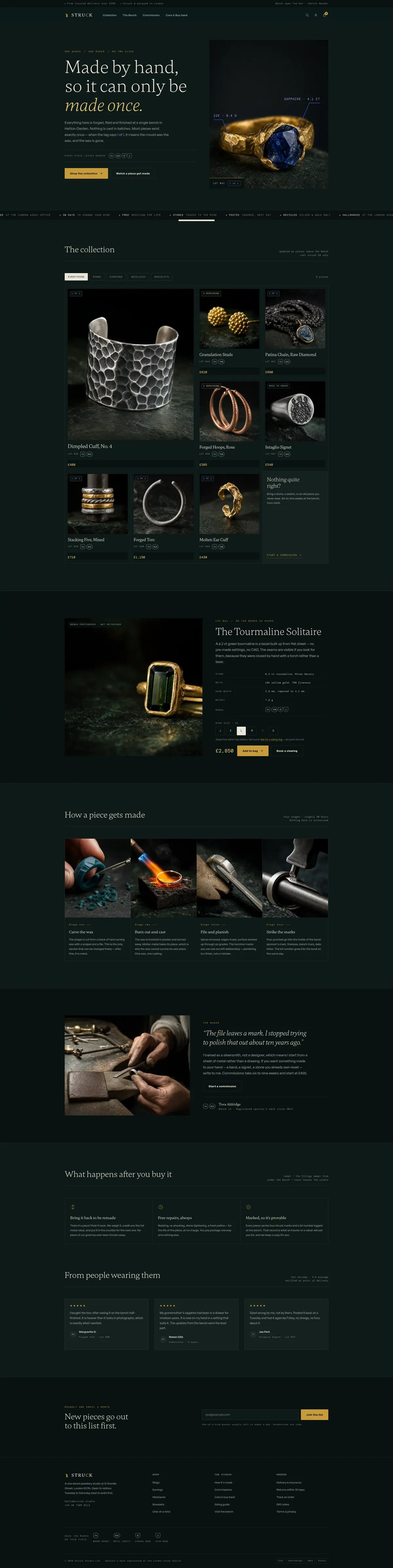
Six complete storefronts, in the categories Etsy is built on. Concept brands, production builds — the labels are invented, so there is nothing under wraps and you can open every one of them full-size.
-
 CONCEPT BUILD
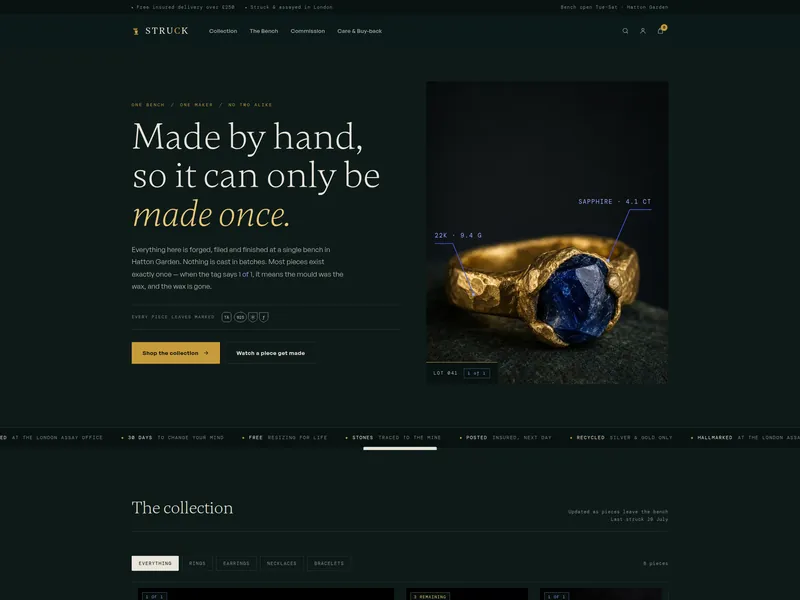
 Struck Handmade jewellery The category Etsy is built on, done as a brand: one-of-one pieces, hallmarking and provenance carried through the product page. -
 CONCEPT BUILD
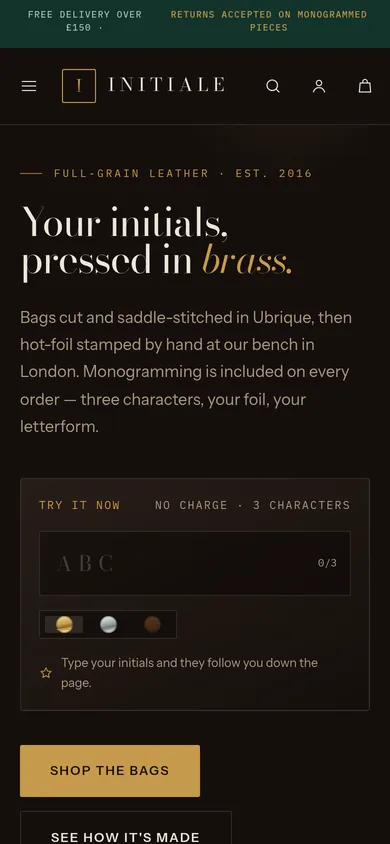
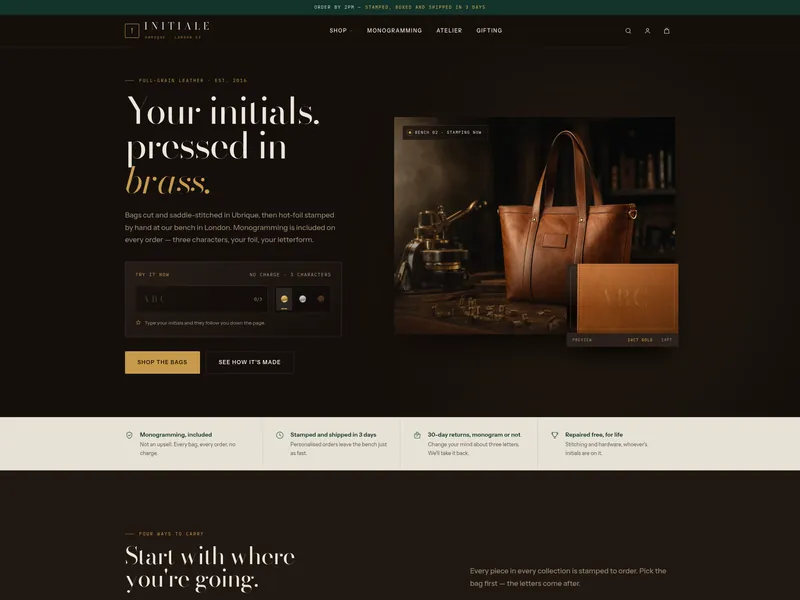
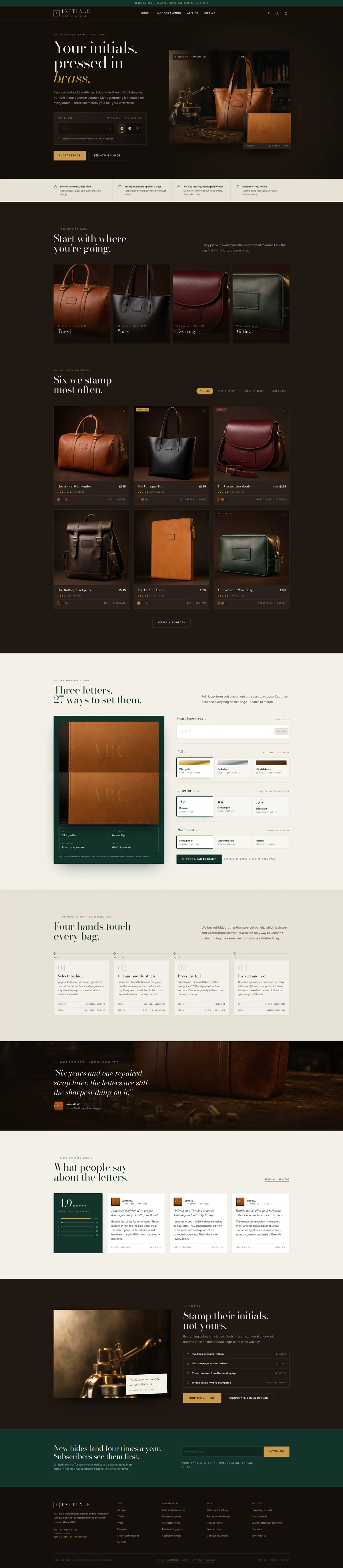
 Initiale Personalised leather goods Personalisation handled properly — live monogram preview built into the page, not a £30/month app bolted on. -
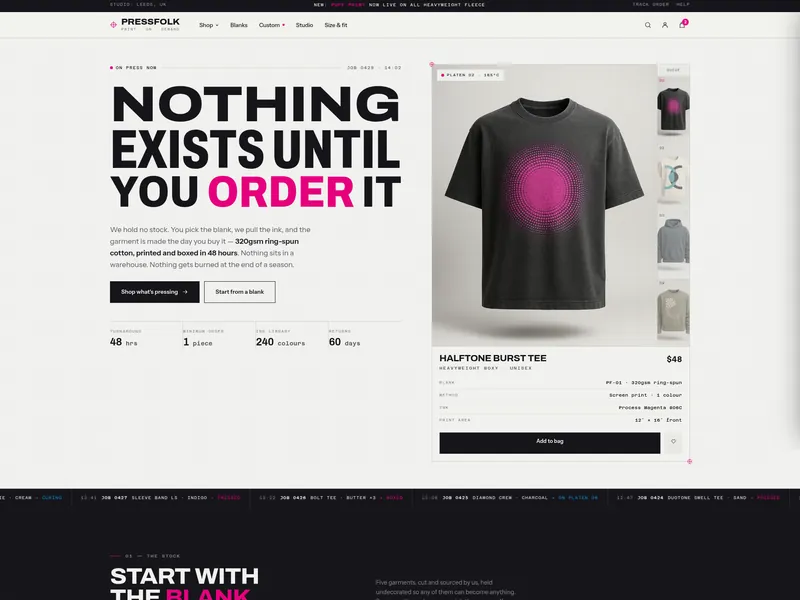 CONCEPT BUILD
 Pressfolk Print-on-demand apparel Made-to-order made legible: pick a blank, pick the ink, printed on order with live press status. -
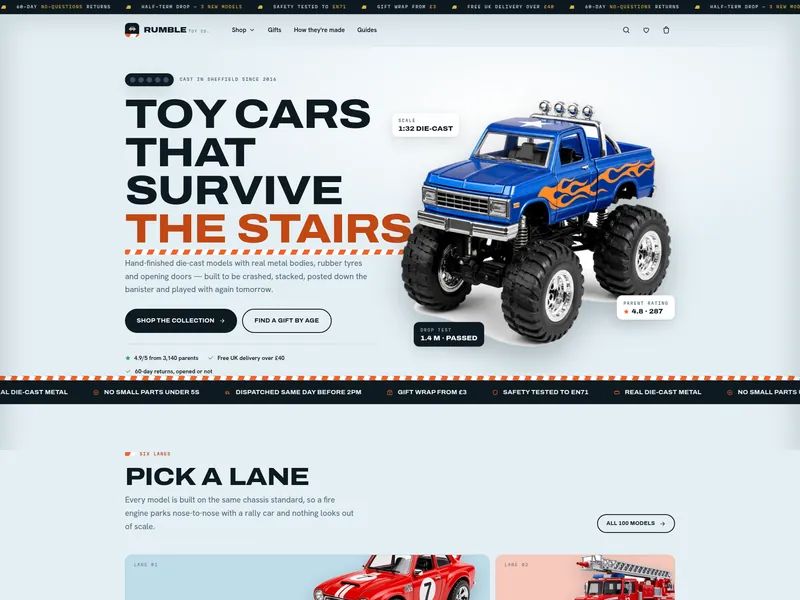 CONCEPT BUILD
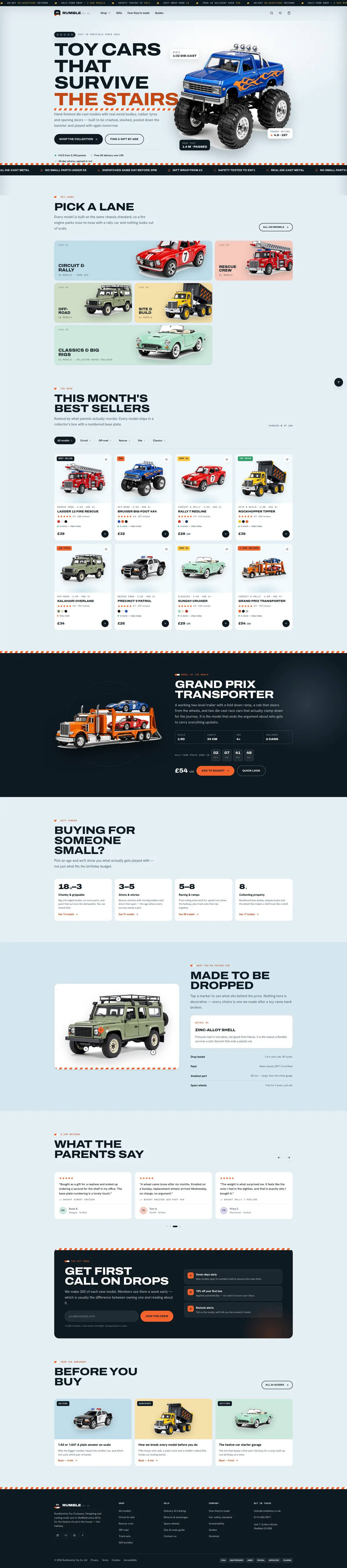
 Rumble Die-cast toy cars Sold to parents rather than collectors — shop-by-age routing, safety standards and gifting surfaced up front. -
 CONCEPT BUILD
 Carapace Phone cases Materials-led storefront: drop-test figures, colourway switching and fitment treated as first-class product data. -
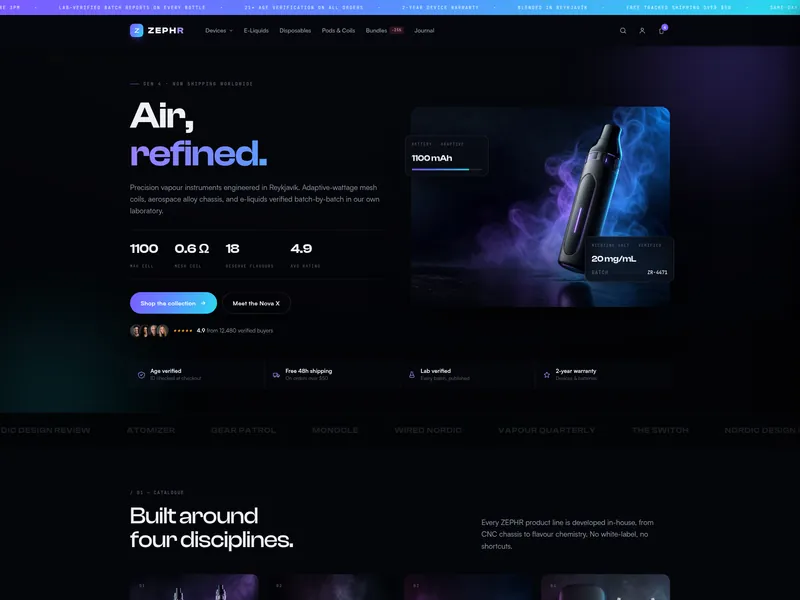 CONCEPT BUILD
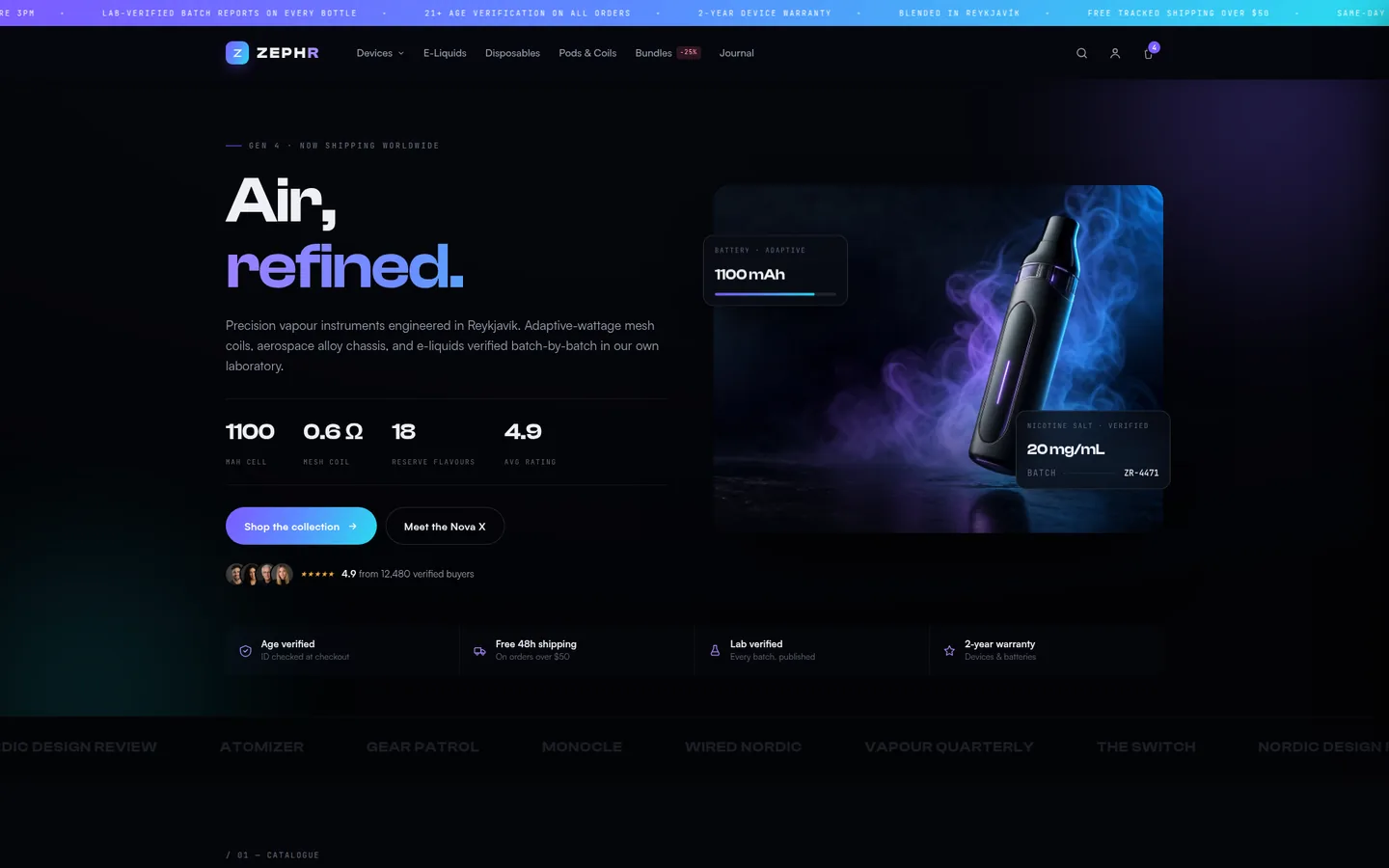
 Zephr Vape devices & e-liquids A compliance-heavy category done properly: age verification, batch-level lab reports, spec-led product pages.



The part worth checking yourself
How long until it has paid for itself?
Two things change on the orders that come through your own door. Etsy stops taking its cut — transaction fee, payment processing, and listing renewals every four months whether the item sold or not. And the apps most migrated sellers end up renting for personalisation and upsells are built into your theme instead, so they never start.
Put your real figures in. Nothing is sent anywhere and no email is required — this runs entirely in your browser, and you are welcome to the arithmetic whether or not we ever speak.
RATES CHECKED: AUGUST 2026 · VERIFY AT ETSY.COM/LEGAL/FEES
This assumes those sales actually happen on your own store, and on day one your store has none of Etsy’s traffic. Nobody moves every order across — move half and the payback takes twice as long, which is still a number worth knowing. Etsy orders keep paying Etsy; this only ever counts the ones that come through your own door.
One build. One number.
No tiers to choose between and nothing bolted on at the end. The things you would be charged separately for elsewhere — carrying your reviews across, the packaging bridge, the email flows — are the things this exists to do.
The full migration
For established Etsy sellers who want a second door — one they own, with the machinery to actually bring people through it.
- A storefront, not a template
- Every listing, every variant, every review
- The card in the box
- Email that runs without you
- Yours, and you can actually run it
Over ~300 listings, heavy variant pricing, or functionality the standard build doesn’t cover. We tell you before you commit, not after.
Your homepage, designed around your actual products · Within 5 working days · No cost, no obligation
- 01
Your free mockup
Send your Etsy shop link and we design your homepage — your products, your photography, your colours, laid out as a real storefront you can open on your phone. You see it before you have spoken to anyone and before you have paid anything. We reply the same day either way: the date your mockup will land, usually sooner than the five days above, or a straight answer that you are not ready yet. Under roughly £1,000 a month in Etsy sales, the maths does not work yet — and telling you so costs us a build we did not want.
- 02
Scope and price
If you like the mockup, we look at your catalogue properly and give you one price in writing before any build work starts. No hourly meter, and no discovering halfway through that your 400 variants were not included.
- 03
Build and migrate
The store gets built on a development theme while your listings, photography, variants and reviews are moved across and checked line by line. Your Etsy shop trades normally throughout. Nothing about your income changes while this happens.
- 04
Launch and hand over
We go live, watch the first real orders, and fix whatever the first week surfaces. Then it is yours: the store, the domain, the theme code, the customer list, documented in plain English. No agency keys, no retainer you have to keep paying to keep your own shop online.
What sellers say
Collected after handover, published unedited — typos, four stars and all.
SAMPLE DATA — the reviews below are invented, shown to design the widget. They are replaced with real customer reviews before launch.
- MARK D Outdoor equipmentVERIFIED
Absolutely brilliant. Store went live in just under 3 weeks and we did more in the first month than the whole of last quarter. cant fault it
- sarah jVERIFIED
so happy with our new store!! its exactly what i asked for and the mobile version is beautiful. thankyou so much
- Priya Raghavan Skincare, DTCVERIFIED
We migrated from Wix after two years of fighting it. What I appreciated most was that the discovery call was honest — I was told which of the things on my wishlist would actually move revenue and which were vanity. The build came in on the quoted price with no surprises, and the handover documentation meant my own team could take over the product pages immediately. Genuinely the smoothest agency engagement I have had.
- TOMVERIFIED
Good work overall and the store looks great. Took about a week longer than I expected, though to be fair he flagged the slip early and explained why rather than going quiet on me. Would use again.
- Daniel O'Connor Coffee subscriptionVERIFIED
Our old theme scored 31 on mobile pagespeed. After the rebuild it is in the high 80s and the bounce rate on phones has dropped off a cliff. That was the whole reason I hired him and it got done.
- lucy
great communication, fast, would recommend
- Aleksandra W.VERIFIED
He replaced four paid apps with things built straight into the theme. That alone is saving us about £150 a month, so the build has more or less paid for itself already. Very happy.
- James Whitfield MenswearVERIFIED
I came in sceptical because we had been burned by a previous developer who disappeared halfway through. This was the opposite experience: clear scope up front, a fixed price agreed in writing, weekly updates, and everything handed over in our own accounts at the end. Conversion is up meaningfully on the same traffic — the product page rework is doing the heavy lifting there. No hesitation recommending.
- kev
does what it says on the tin. store looks miles better than the template we were using before. only thing i would say is i wish wed done the email flows at the same time instead of leaving them til later
- Hannah M HomewareVERIFIED
What sold me was the handover. Everything is in our Shopify account, in our name, documented in plain English. I have worked with agencies that hold the keys hostage — this was the opposite and I would not go anywhere else now.
The things sellers actually ask
What do I actually get for the free mockup, and what’s the catch?
You get a designed homepage for your shop — your products, your photography, your colours, laid out as a real storefront rather than a wireframe. It arrives as a real page you can open and scroll on your phone, not a flat picture in an email — it is the same foundation your store would be built on, so what you are looking at is what you would get, not an artist’s impression of it. We reply the same day with the date yours will land, and it is with you inside five working days. The catch, such as it is: we can only do a handful a month, and we ask for your Etsy shop link so we can see what we are working with. No call, no card, and if you take the mockup and build the store yourself, that is a genuinely fine outcome — you will know more than you did.
Do I have to close my Etsy shop?
No, and we would argue against it. Etsy is the best top-of-funnel most small makers will ever get — people arrive there already intending to buy handmade. Closing it throws that away to save a fee. What changes is that Etsy stops being the only place you exist: it becomes how strangers find you, and your own store becomes where the people who already love you come back to. Almost every seller we work with runs both, indefinitely.
Won’t I just have a store that nobody visits?
On day one, yes — and any agency that tells you otherwise is selling you something. A new store has no marketplace search behind it. What it does have is every customer who has already bought from you, which is the cheapest audience in commerce and the one Etsy will not let you contact. The first months are about moving those people across: package inserts, your existing social following, the buyers who already search your shop name. That is the actual work, and it is why the store call starts with what share of your Etsy traffic already comes looking for you by name.
Can I move my reviews? They took me years to get.
Yes, and better than you might expect. Your Etsy reviews sync across through Judge.me — the text, the rating, the photos buyers attached and the verified badge, matched to the right product automatically by SKU. It keeps syncing too, so a review left on Etsy next month still appears on the store you own. What we will not do is silently reattribute them or dress them up as something they are not: they show as what they are, reviews earned on your marketplace shop, which is both honest and more convincing than a wall of anonymous five-stars.
What about my listings — I have hundreds, with variants.
They get migrated properly: products, variants, options, quantities, SKUs, photography and descriptions, mapped into a real Shopify catalogue rather than dumped through a generic importer that flattens your options and loses your sizing. Shopify allows three option types per product where Etsy allows two, so nothing has to be squeezed to fit — if anything you get room you did not have. Very large catalogues take longer to check line by line, and that is the main thing that moves the price.
What happens to my personalised listings?
They work the same way they do on Etsy, which is simpler than people expect. Etsy personalisation is one instruction line and one text box; on your store that becomes a native field on the product page that carries through to the cart, the checkout, your order emails and your admin, so you see the monogram on the order exactly like you do now. It is built into the theme rather than added as a £25-a-month app subscription. If you charge extra for personalisation, say so early — priced add-ons work differently and we will tell you how before you commit.
Will Etsy penalise me for putting a card in the box?
Not for the card we design, no — but the distinction matters and it is worth being precise about. Etsy’s policies are hostile to soliciting buyers off the platform, so a card that says “buy direct next time and save 10%” is genuinely risky. What goes in your packaging is a brand touchpoint: register your piece, get the care guide, hear about restocks first. The buyer scans, lands on your store and joins your list — which is the entire point — without you having asked them to take their next Etsy order elsewhere. If you would rather not put anything in the box at all, the store still works; you just lose the fastest route to your own list.
How much does it cost, honestly?
From £1,495, and most shops land between £1,495 and £2,995. Everything on this page is in that — the store, the migration, your reviews, the packaging bridge, Klaviyo and the handover. There are no extras to add at the end, which is deliberate: charging separately for carrying your reviews across, when those reviews are the thing you have spent years earning, is not a trick we wanted to run. What moves the number is over ~300 listings, heavy variant pricing, or functionality the standard build doesn’t cover. We tell you before you commit, not after. You get one price in writing after you have seen your mockup, and it does not move unless you add to the scope.
Is this worth it if I only do a few hundred pounds a month?
Probably not yet, and we would rather say so now than take the money. Under roughly £1,000 a month in Etsy sales, the fee saving does not cover the platform cost and the effort, and your time is better spent getting the Etsy shop to sell more. Come back when you have repeat buyers asking whether they can order from you directly — that question is the actual signal that you are ready.
Do I own it, or am I renting it from you?
You own it. The store lives in your Shopify account under your billing in your name, the theme code is yours, the domain is yours, the customer list is yours, and everything is documented so any other developer can pick it up. There is no monthly fee to us keeping your shop online. Ask any agency that question in writing before you hire them.
Next step
See your shop with its own front door.
Send us your Etsy link and we’ll design your homepage — your products, your photography, laid out as a real storefront you can open on your phone. We reply the same day with the date it’ll land, and it’s with you inside five working days. No call, no card, no obligation. If what we find is that you’re not ready to move yet, we’ll tell you that instead.
Your homepage, designed around your actual products · Within 5 working days · No cost, no obligation